
How to fix PH taxes to attract investors — from red tape to red carpet

At the 2026 Economic Ease of Doing Business (EODB) Briefing held at the Asian Development Bank (ADB), one message resonated strongly: The Philippines is overtaxed, yet underserved.
The phrase, highlighted during the presentation of global tax policy expert and Chief Tax Advisor of Asian Consulting Group (ACG) Mon Abrea, reflects a growing sentiment among taxpayers and investors — that while Filipinos face multiple layers of taxes, the ease of compliance and quality of public services remain below expectations.
More importantly, it points to a deeper issue: The problem is not just how much we tax, but how the system is designed and administered.
Watch Abrea’s presentation here: https://youtu.be/cC5WinAbGFA
Organized by the Anti-Red Tape Authority (ARTA) in collaboration with the Asian Development Bank (ADB), the briefing gathered key government officials, including representatives from the Department of Finance (DOF), Bureau of Internal Revenue (BIR), and Bureau of Customs (BOC), to advance fiscal compliance, transparency, and seamless government processes.
The event was attended by members of the diplomatic corps, foreign chambers of commerce, industry leaders, and policymakers — reflecting strong public-private collaboration in improving the country’s business environment.
A system that burdens growth
The Philippines continues to face governance and competitiveness challenges. With a Corruption Perceptions Index (CPI) score of 32/100, investor confidence remains constrained, while businesses deal with: complex and overlapping tax rules, high compliance costs, frequent audits and discretionary enforcement, and delays in VAT refunds and approvals.
The result is a system that is heavy on compliance, but light on efficiency and service delivery. This imbalance discourages investment, weakens voluntary compliance, and ultimately limits revenue potential.
While reforms have improved ease of doing business, ease of paying taxes remains a key bottleneck.
Globally competitive economies focus not only on tax rates but on predictability, transparency, and efficiency. Countries such as Singapore, Vietnam, and Indonesia have invested heavily in digitalization and streamlined systems to attract investors.
For the Philippines, improving competitiveness requires modernizing tax administration — not just adjusting tax policy.
From red tape to red carpet
At the EODB briefing, government leaders emphasized that ease of doing business is ultimately about building trust — between the government, taxpayers, and investors.
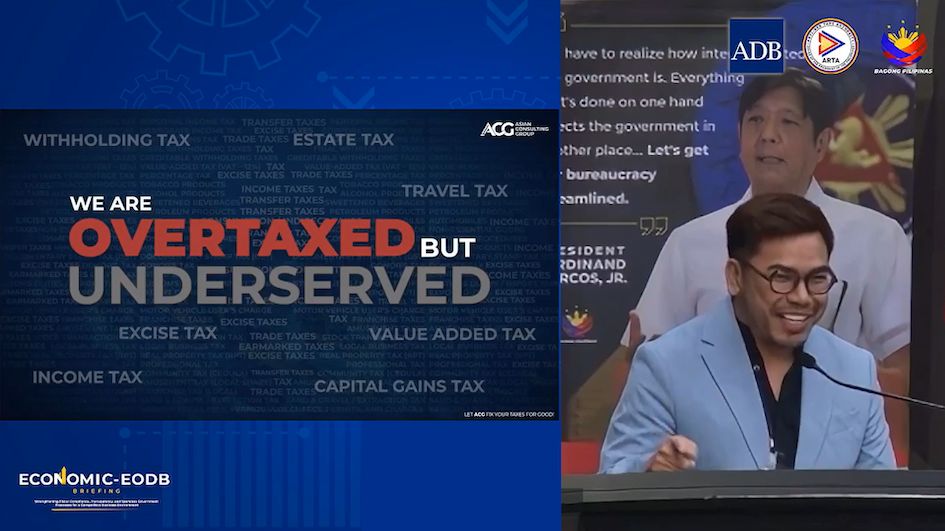
Transforming the Philippines into an investment destination requires moving from red tape to red carpet.
This means reducing discretion, simplifying processes, and making compliance easier and more predictable.
A comprehensive reform agenda for competitiveness was presented to align the Philippines with global standards:
- AI-driven, risk-based audit to target large-scale tax evasion instead of burdening MSMEs
- Adoption of the OECD Global Minimum Tax to capture fair revenues from multinational enterprises
- Reducing VAT from 12% to 10%, while strengthening enforcement to broaden the base
- Increasing income tax exemptions to provide relief to workers
- Lifting bank secrecy for tax enforcement to improve transparency
- Imposing a recovery tax on unexplained wealth to deter corruption
At the institutional level, a more structural reform is proposed: The creation of a National Revenue Authority, integrating tax and customs systems to improve efficiency, data sharing, and accountability.
Taking the conversation global
These reforms are part of a broader effort to position the Philippines as a competitive investment destination.
On February 26, 2026, the Asian Consulting Group (ACG) will launch the 2026 International Tax and Investment Roadshow, covering key cities across Asia, the Middle East, Europe, North America, and Australia.
Alongside it is the launch of the book: WHY INVEST IN THE PHILIPPINES? — CREATE MORE Edition: A practical guide for global investors, bringing together insights from economic managers, ambassadors, and industry leaders.
The Philippines has strong economic fundamentals — but unlocking its full potential requires restoring trust in its institutions.
Tax reform is not just about raising revenues. It is about creating a system that is fair, efficient, and predictable. Because in today’s global economy, countries do not compete on tax rates alone. They compete on trust.
And until taxpayers feel that they are served as much as they are taxed, the Philippines will remain overtaxed but underserved.
To invite Mr. Abrea for interviews or briefings, email consult@acg.ph.
**
Mon Abrea is a tax policy expert and the founder and chief tax advisor of Asian Consulting Group, advising governments, multinational firms, and investors on tax reform and investment strategy. He holds degrees and executive training from Harvard University, Duke University, and the University of Oxford.


No comments: