
PH pushes critical mineral partnerships at OECD forum in Türkiye

The Philippines reinforced its position as a key player in the global critical minerals industry as it championed strategic international partnerships and supply chain resilience during the Organisation for Economic Co-operation and Development (OECD) Critical Minerals Forum in Istanbul, Türkiye.
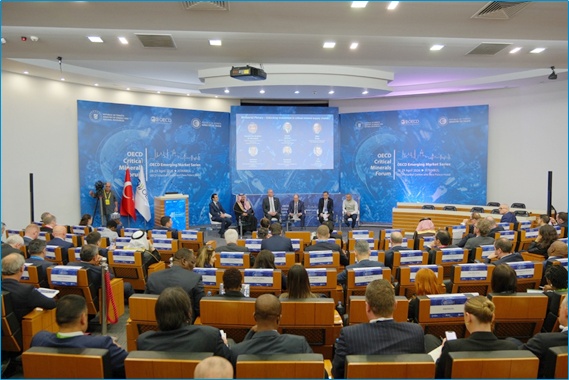
Representing the country at the High-Level Ministerial Panel on “Unlocking Investment in Critical Mineral Supply Chains” was Ceferino Rodolfo, Department of Trade and Industry (DTI) Undersecretary and Managing Head of the Board of Investments (BOI).
The panel gathered senior global leaders and industry stakeholders, including Bandar bin Ibrahim Al-Khorayef, Minister of Industry and Mineral Resources of Saudi Arabia; Karim Badawi, Egypt’s Minister of Petroleum and Mineral Resources; Mike Kopp of the U.S. Department of Energy; and Rohitesh Dhawan, CEO of the International Council on Mining and Metals.
Held on April 28, the ministerial panel tackled rising global demand for critical minerals, supply chain vulnerabilities, geopolitical risks, and the growing need for diversified and sustainable sources of strategic resources essential to the global energy transition.
The Philippines drew significant attention during the forum as the world’s second-largest nickel producer and one of the most critical suppliers of nickel ore and concentrates globally.
PH positioned as strategic nickel partner
Rodolfo emphasized that the Philippines is moving beyond its traditional role as a raw material exporter by strengthening mineral processing and refining capabilities while aligning regulations with international sustainability standards.
“The Philippines is emerging as a critical source of nickel at a time when supply chain diversification and resource resilience have become paramount concerns for the global economy,” Rodolfo said.
He noted that the country presents strong opportunities for responsible and high-quality investments as global economies seek secure and diversified critical mineral supply chains.
The Philippines currently accounts for more than one-fourth of global nickel ore and concentrate exports, with over 98% of shipments going to China and around 1% to Japan. China sources more than 80% of its nickel import volume from the Philippines, while Indonesia’s imports from the country have grown by an average of 30% annually over the past five years.
‘Three Ps’ strategy
Rodolfo outlined the Philippines’ “Three Ps” strategy — Policy, Permitting, and Partnership — aimed at accelerating the development of a globally competitive and sustainable mining industry leading to a fourth “P”: bankable Processing Projects.
Under the Policy pillar, Rodolfo cited the proposed “Enhanced Fiscal Regime for Large-Scale Metallic Mining Act,” designed to promote equitable revenue sharing, fiscal transparency, and sustainable development in the mining sector.
For Permitting, the government is pushing to streamline the mining approval process from 11 years to just 11 months while maintaining strict compliance with environmental, labor, and governance standards.
On Partnership, Rodolfo stressed the importance of collaboration between government and the private sector, as well as deeper international cooperation, instead of restrictive approaches that could hamper investments and industry growth.
He also highlighted the Philippines’ growing collaboration with the United States, particularly the AI Native Industrial Acceleration Hub planned for New Clark City. The proposed 4,000-acre development aims to support energy transition initiatives, advanced manufacturing, and artificial intelligence-driven industrial growth.
Building resilient supply chains
The OECD forum underscored the growing global consensus that no single country can independently secure the future of critical mineral supply chains amid rising geopolitical and economic pressures.
From major suppliers to leading industrial economies, participants stressed the need for stronger cooperation to ensure resilient, diversified, and sustainable supply chains while enabling resource-rich countries like the Philippines to expand local value creation and economic diversification.
For the Philippines, the forum reinforced its strategic role not only as a major mineral supplier but also as an emerging investment destination in downstream processing, clean energy transition, and advanced industrial development.


No comments: